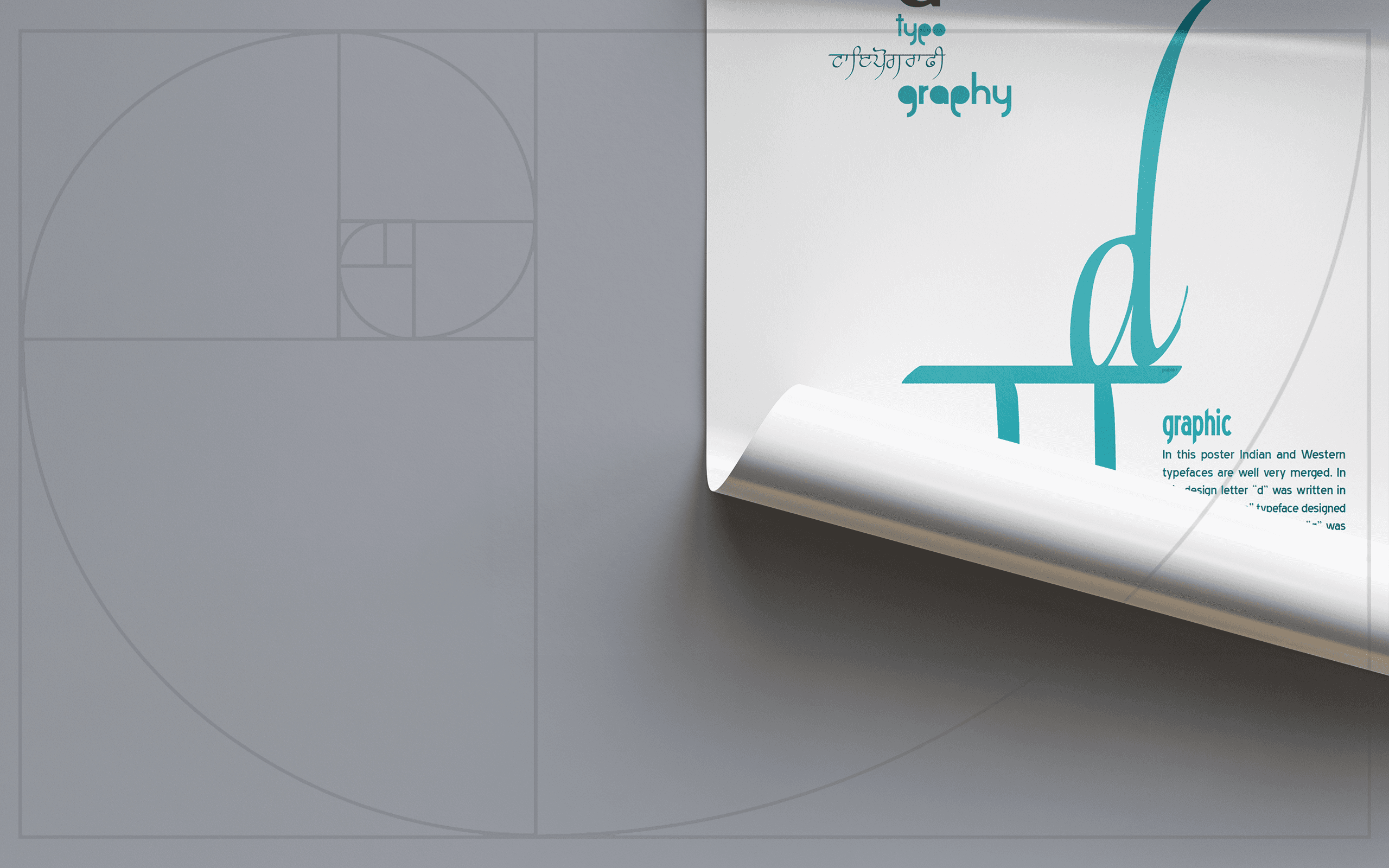
TYPOGRAPHY POSTER
The Common Curve
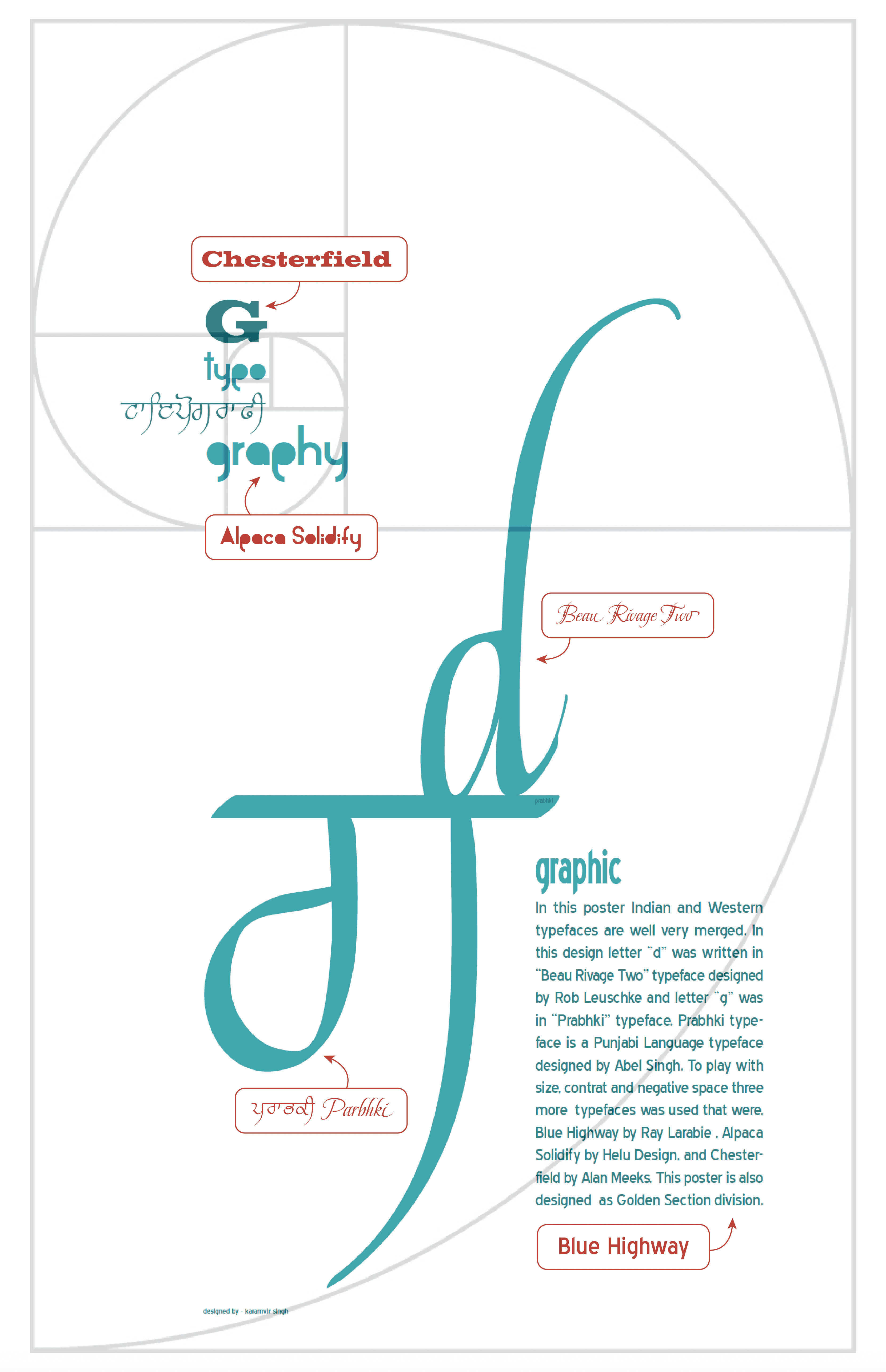
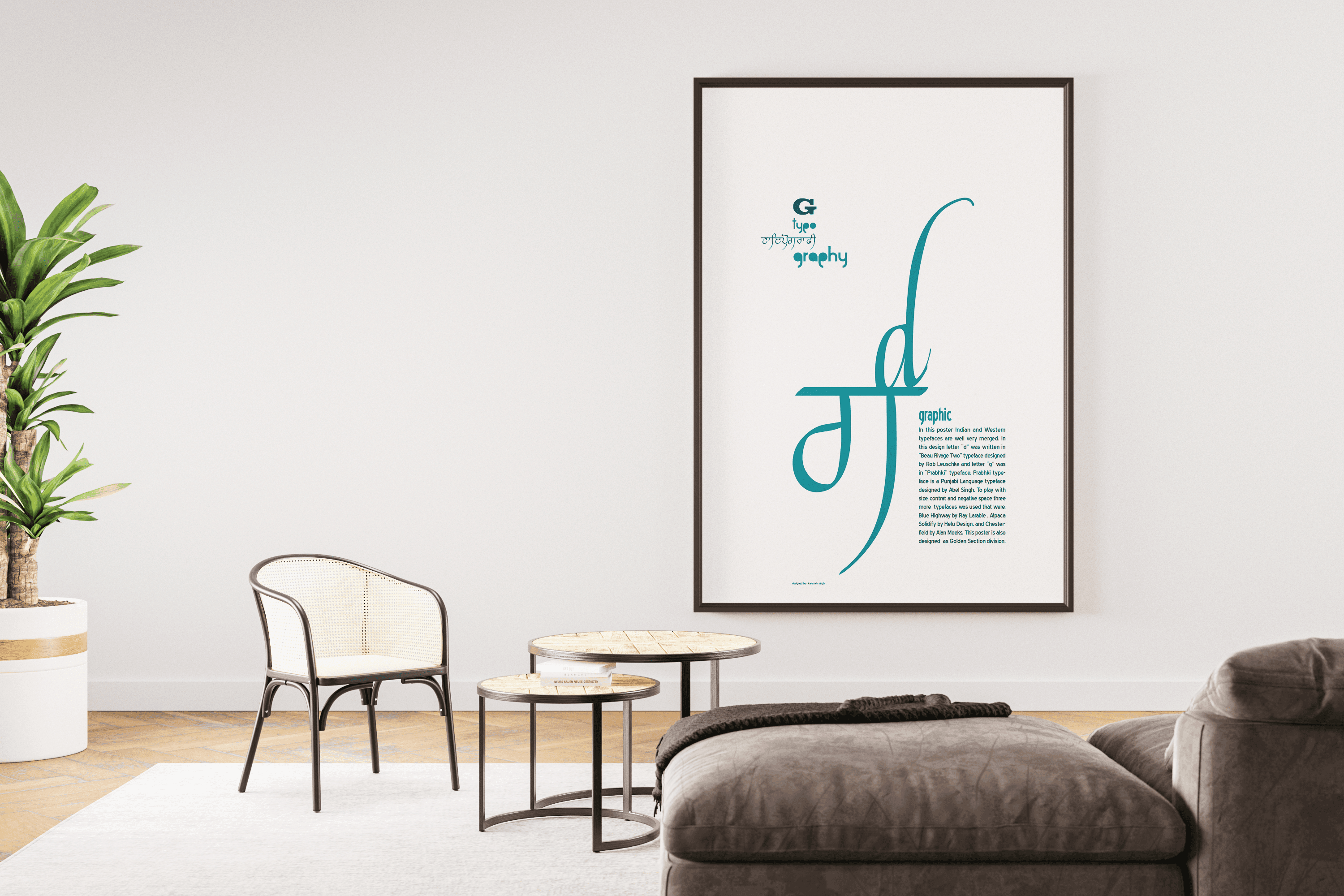
A typographic poster built around two letterforms: Punjabi ਗ for graphic and Western d for designing — the profession spelled across two scripts.
Roles: Graphic Designer
TheBrief
The project called for a personal typeface list poster — a document that curates a typographer's chosen typefaces and presents them as both reference and design object in their own right.
The opportunity was to make the poster itself an argument: rather than simply listing typefaces on a neutral field, the design would demonstrate the concept it was built around. The concept chosen was cultural fusion — placing a Punjabi-language typeface in direct dialogue with Western display and decorative faces, merging two typographic traditions into a single cohesive poster.
The brief required the selection of at least five typefaces, a defined colour palette, and a clear design concept. The final deliverable was a print-ready A2 poster accompanied by a rationale and process documentation.
CORE CONCEPT
Cultural Fusion
Bilingual Type
Golden Section
Negative Space
Contrast
DesignProcess
Research & Curation
Typeface selection began with the cultural premise. Prabhki — a Punjabi-script typeface designed by Alba Singh — was chosen as the conceptual anchor. Western faces were then selected to complement it: a calligraphic script, a bold display face, a clean sans-serif, and a decorative serif to build contrast and range.
Thumbnail Ideation
Nine thumbnail sketches explored different compositional approaches from symmetrical grids to dynamic diagonal layouts. The recurring instinct across iterations was to let a single large letterform dominate the composition, reducing the hierarchy to an essential tension between two glyphs: one Western, one Punjabi.
Refinement & Layout
The final composition uses a Golden Section division to structure the poster into a primary zone (the large letterforms) and a secondary zone (the typographic identity stack). The two large letters — "d" in Beau Rivage Two and the Punjabi "g" in Prabhki — interlock across the grid line, creating a form that is neither fully Western nor fully South Asian.
TypefaceSelection
Prabhki Albel Singh · Prabhki
Cultural Anchor
A Punjabi-script typeface that forms the conceptual heart of the poster. The large Gurmukhi character "ਗ" displayed on the poster is the Punjabi letter for g — standing for graphic. Paired with the Western "d" for designing, the two letterforms together spell out the designer's own profession across two scripts and two cultures.
Beau Rivage Two Rob Leuschke · TypeSETit
Hero Form
A Western calligraphic script that provides the dominant letterform on the poster. The large "d" stands for designing — the second half of the phrase "graphic designing," completed by the Punjabi "ਗ" on the left. Its sweeping calligraphic strokes mirror the organic quality of Prabhki, creating visual harmony across the two scripts.
Alpaca Solidify HeluDesign
Contrast
A bold display face used in the typographic identity stack to create weight contrast against the calligraphic forms. Its solidity grounds the composition and anchors the uppercase G that introduces the "graphic" wordmark.
Blue Highway Ray Larabie · Typodermic
Utility · Spacing
A clean, open sans-serif used for body text and secondary labels. Its wide letter-spacing and geometric construction provide breathing room within the dense composition, letting the decorative forms stand out.
Chesterfield Alan Meeks · Altsys
Decorative · Historical
A decorative serif face with strong period character, used to introduce texture and historical depth into the composition. Together with Alpaca Solidify and Blue Highway, it completes a tonal spectrum from heavy to light, decorative to utilitarian — giving the poster the range needed to demonstrate typographic contrast.
ColorPalette
The palette is intentionally restrained to two CMYK teal values on white. The teal was chosen for its cross-cultural neutrality — it belongs to no single design tradition — while its depth gives the large calligraphic letterforms enough visual mass to carry the composition without relying on additional colour. The white field maximises the negative space that the Golden Section composition depends on.
Teal - Primary
C91 - M11 - Y36 - K10
Teal - Dark Accent
C91 - M11 - Y36 - K48
DesignApproach
The poster is structured on a Golden Section grid: a vertical proportion of approximately 1:1.618 divides the field into a larger upper zone and a smaller lower zone, while a corresponding vertical division anchors the typographic stack. This classical proportion was chosen deliberately — it belongs to a shared mathematical heritage that transcends any single culture, making it an appropriate structural foundation for a poster about cultural fusion.
The central design gesture is the collision of two letterforms at the grid intersection: the cursive Western "d" from Beau Rivage Two and the Punjabi "ਗ" from Prabhki. These are not arbitrary glyphs — "ਗ" is the Punjabi letter for g, standing for graphic, while "d" stands for designing. Together they spell out the designer's own profession — graphic designing — split across two scripts and two cultural traditions. Neither form dominates the other; they share the vertical axis, their curves echoing each other across the script boundary. The concept is stated entirely through letterforms, with no explanatory text needed.
Size, contrast, and negative space are managed through the remaining three typefaces. Blue Highway provides scale contrast at small sizes; Alpaca Solidify delivers bold weight at the G in the stacked logo; Chesterfield adds historical texture at display size. Together they give the composition its tonal range without competing with the two hero letterforms.
FinalDesign

Outcome&Reflection
5
Typefaces across two scripts and three design traditions — calligraphic, display, and utilitarian.
φ
Golden Section proportion governing both the horizontal and vertical divisions of the poster field.
2
Scripts in direct visual dialogue — Gurmukhi and Latin — sharing a single poster surface and tonal palette..
The project demonstrated that typographic culture is not a monolith. By placing Prabhki alongside Western calligraphy and display faces, the poster argues — through form rather than text — that script traditions need not be separated by design convention. The Golden Section gave the composition a mathematical integrity that let the cultural argument speak without a frame. The restraint of the two-colour palette proved essential: it was the shared visual language that made the dialogue possible.